What is A2RL?
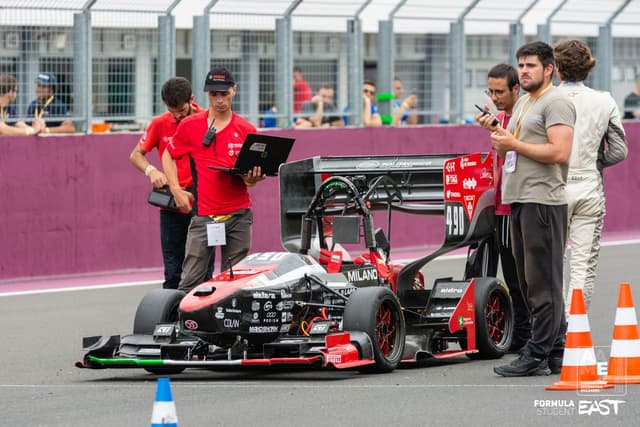
The Abu Dhabi Autonomous Racing League (A2RL) is the first competition to run fully autonomous race cars in a multi-vehicle, head-to-head format on a professional circuit, Yas Marina. Every team fields the same car — the Dallara-built EAV-24, derived from the Super Formula chassis — so the only differentiator is software: perception, prediction, planning, and control.


With identical hardware across the grid, races are won in the autonomy stack: how well the car perceives its opponents, plans its line, and reacts in real time.
PoliMove
PoliMove is the autonomous racing team of Politecnico di Milano. I worked there as an Autonomy Software Engineer from February to December 2024, during the team's A2RL campaign.
My Role
Software for the EAV-24
My main focus was the EAV-24 (Super Formula), the platform on which PoliMove ran its A2RL campaign.


Trajectory planning for head-to-head racing
I designed and improved the trajectory planning algorithms for multi-agent, head-to-head scenarios. The planner has to:
- Account for track layout and current grip conditions
- Predict opponent behavior and movements
- Compute racing lines and identify overtaking opportunities
- Adapt the trajectory in real time, trading performance against safety
Overtake-zone estimation
Deciding where an overtake is feasible is one of the harder problems in autonomous racing. I developed the overtake-zone estimation for road courses, combining:
- Track geometry
- Vehicle dynamics
- Opponent position and speed
- Current race strategy
A wrong overtake decision costs more time than a conservative one — the estimate has to be reliable, not optimistic.
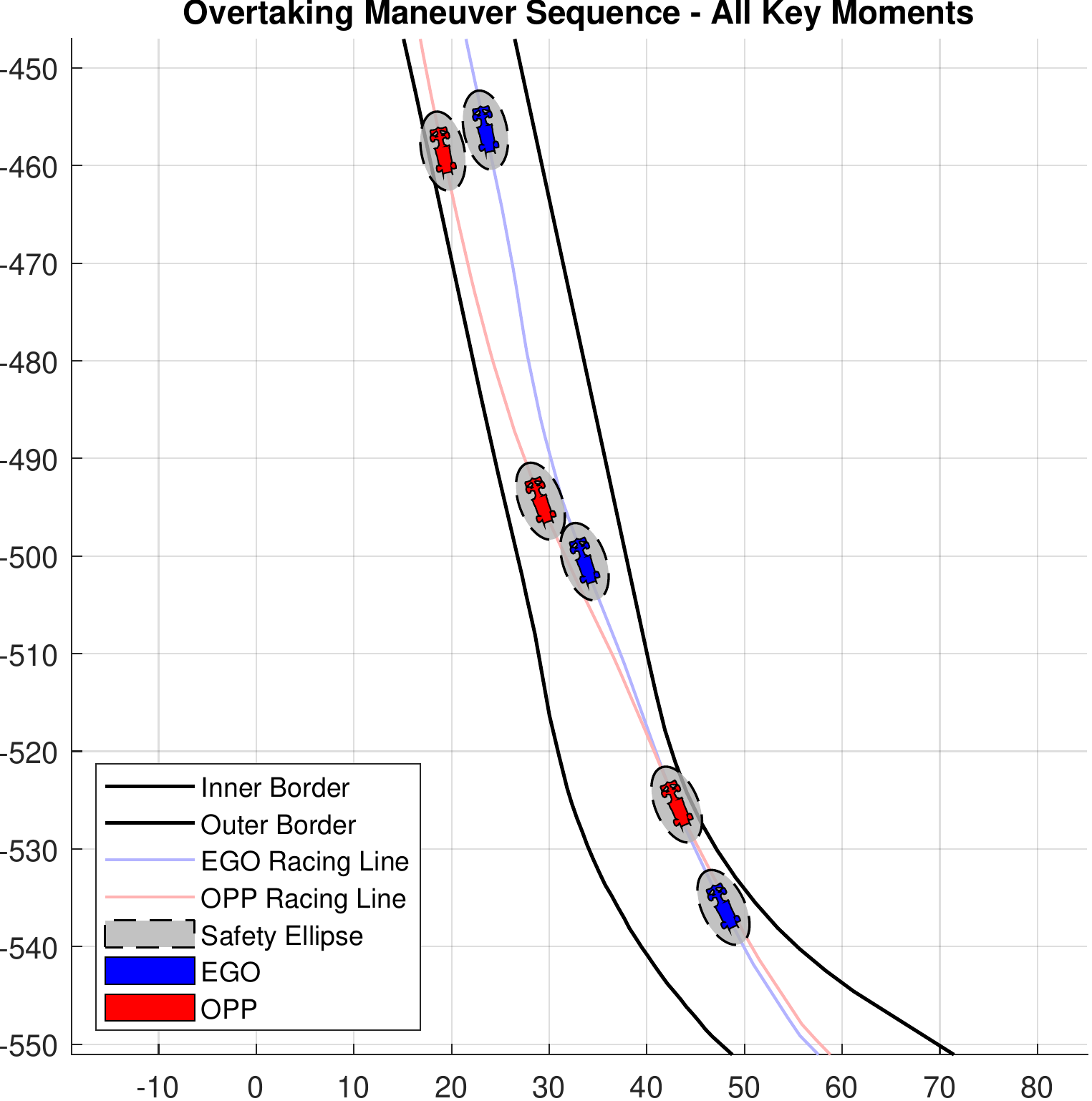
An optimized overtaking maneuver: the EGO car (blue) pulls out of the slipstream of the opponent (red) and completes the pass, with safety ellipses enforcing clearance around each vehicle at every key moment.
Vehicle and opponent modeling
Two modeling efforts supported all of the above:
-
Car dynamics: accurate models of the EAV-24's behavior across conditions, so the planner can use the full performance envelope without exceeding it.
-
Opponent behavior: predictive models of the other vehicles on track, so the system acts proactively rather than reactively.
Both were refined continuously against track data and simulation results.
Results
- 1st place, Attack-Defense Competition
- 1st place, Time-Trial Competition — with a lap time within 15% of the F1 benchmark at the same circuit
What Transfers Beyond Racing
A2RL compresses the core problems of autonomous driving into their hardest form: perception and prediction at 250+ km/h, planning under uncertainty, decisions in milliseconds, and safety with no driver to fall back on. Opponent prediction, real-time planning, and robustness at the limit are the same problems road autonomy has to solve — racing just removes the margin for error.
Fixing the hardware across all teams turns the competition into a pure software benchmark. That is what makes A2RL valuable beyond the show: it is one of the few places where autonomous driving stacks are compared head-to-head, at speed, with nowhere to hide.