Beyond Behavior Cloning: Closed-Loop Training for Embodied Autonomy
Embodied AI stands at a critical juncture. Whether the agent is a manipulator, a quadruped, a drone, or a vehicle, behavior cloning has enabled impressive demonstrations of end-to-end policies — but a fundamental gap threatens to limit further progress: policies trained on static demonstrations must operate in a dynamic, interactive world where every action shapes future observations. This article explores how closed-loop training techniques are reshaping the path toward robust autonomy.
Many of the clearest examples come from autonomous driving, the domain where these ideas are most battle-tested, so I will use it as the running example — but every failure mode and every remedy applies to robots learning from demonstrations in general. The article draws on, and roughly follows the structure of, NVIDIA's recent survey Beyond Behavior Cloning in Autonomous Driving: a Survey of Closed-Loop Training Techniques (Karkus, Igl et al., 2025), supplemented with references from the broader robotics literature.
TL;DR
- Behavior cloning fails in deployment because the training distribution (fixed, expert-generated) doesn't match the deployment distribution (induced by the policy itself). Small errors compound into states the policy has never seen.
- Closed-loop training fixes this by rolling out the policy during training and scoring those rollouts — with expert labels (imitation), a reward function (RL), or both.
- Everything is a design choice along three coupled axes: how to generate actions, how to generate environment responses, and what objective to train on.
- No free lunch: on-policy data targets real failures but is expensive; high-fidelity sims don't generalize far from logs; rewards get hacked; expert labels break far from demonstrations.
- Today's pragmatic recipe: open-loop pre-training + targeted closed-loop fine-tuning — the embodied mirror of pre-training and alignment in LLMs.
How to read this article: Part I for the problem, Part II for the framework (these two carry the core ideas). Parts III–V dive into each design axis, VI–VIII cover couplings and frontiers. Each part ends with key takeaways.
Part I: Understanding the Problem
The Promise and Peril of Behavior Cloning
Behavior cloning operates on an elegant but flawed premise: train a neural network to predict expert actions given observations, treating each moment as independent from the next. The approach works remarkably well for initial development and scales with the massive datasets of human demonstrations collected by robotics and AV companies alike.
However, reality imposes a harsh constraint. During deployment, any deviation from the expert trajectory — however slight — pushes the agent into states it never encountered during training, and errors compound: in driving, a steering miscalculation of a few degrees becomes a lane departure within seconds; in manipulation, a small grasp error becomes a dropped object; in locomotion, a misplaced footstep becomes a fall.
The Open-Loop to Closed-Loop Gap: Five Critical Failures
The mismatch between open-loop training and closed-loop deployment manifests in five failure modes.
Covariate Shift and Compounding Errors: The most severe one. As the policy rolls out, small deviations from the expert amplify over time, pushing it into increasingly unfamiliar regions of the state space — until it is so far from anything it has seen that recovery becomes impossible.
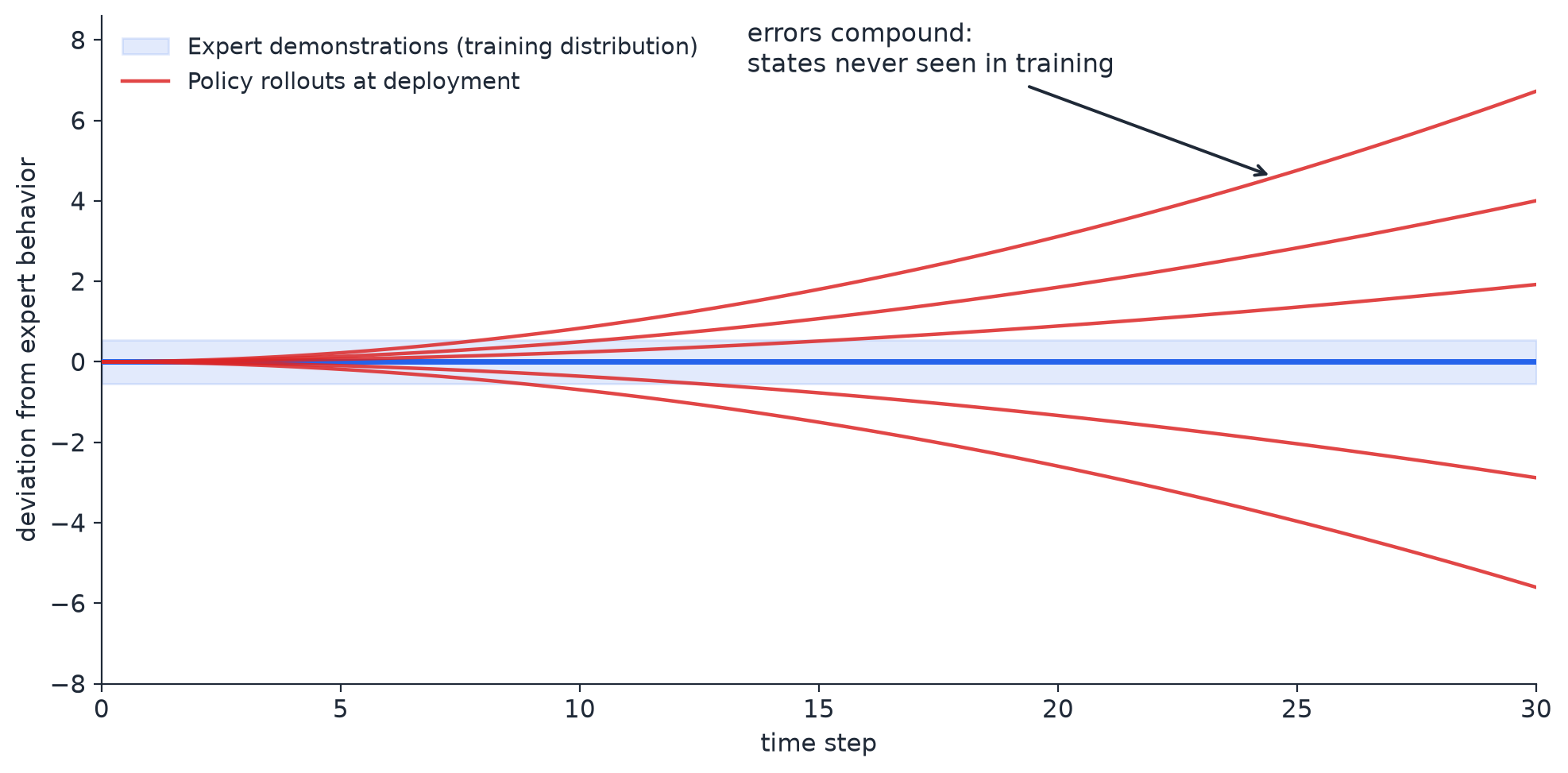
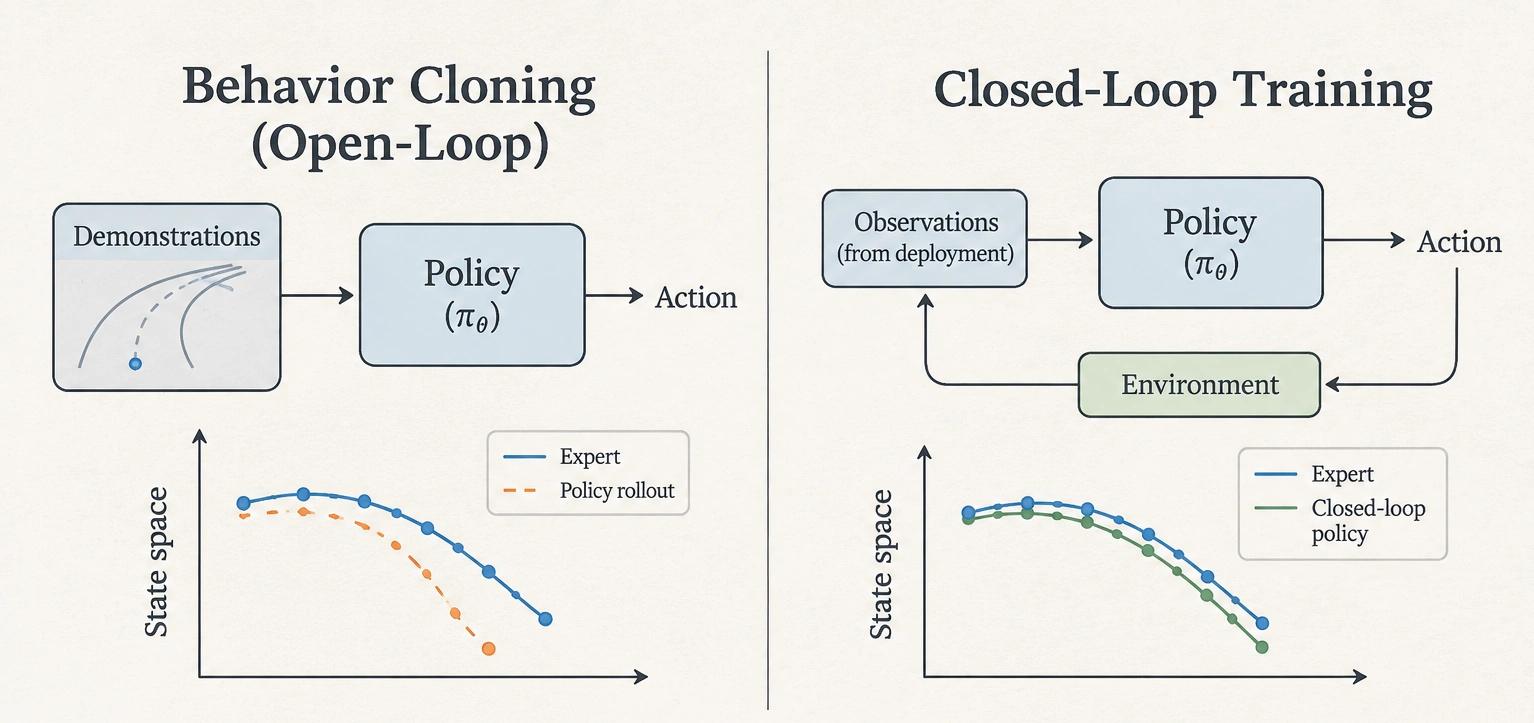
Covariate shift in one picture: training data covers a narrow band around expert behavior, but at deployment small errors compound, pushing the policy into states that were never in the training set — where it has no idea what to do.
Causal Confusion: Behavior cloning can learn spurious correlations instead of causal structure. A classic driving example: the policy brakes when surrounding vehicles slow down, rather than identifying the red traffic light that caused them to brake. In training data the two signals correlate perfectly, so the distinction seems academic; in deployment it becomes catastrophic.
Unmodeled Interactivity: Autonomy is interactive — the agent's actions change the world, and the changed world feeds back into the agent's next observations. A vehicle's behavior changes how other road users react; a mobile robot's path changes how pedestrians move. Trained on passive observation, behavior cloning does not model this feedback: behaviors that look reasonable in isolation can provoke undesirable reactions in practice.
Downstream Control and Physical Dynamics: Predicted trajectories are never executed perfectly — they pass through controllers with latency, noise, and actuation limits. Policies never exposed to these effects during training fail to account for the gap between planned and realized motion.
Long-Tail Events: Rare but critical scenarios are underrepresented in expert data and contribute little to the training loss. Without corrective feedback, policies cannot recover from them — precisely the scenarios that decide whether a system can operate without human supervision.
Critical Insight: Open-loop training assumes independent samples, but closed-loop deployment creates temporal dependencies where today's actions determine tomorrow's observations. This mismatch isn't a minor technical detail—it's a fundamental epistemological challenge.
Part II: The Solution Framework
Closed-Loop Training: Experiencing Consequences During Learning
Open-loop training treats learning as a static prediction problem: minimize imitation error over a fixed dataset of (observation, expert action) pairs, each sample assumed independent of the next. Closed-loop training instead acknowledges what deployment actually looks like — a sequential interaction, where every action feeds back through the environment and shapes the observations the policy receives next. Rather than imitating isolated pairs, closed-loop methods generate complete rollouts, allowing the policy to experience its own compounding errors, practice recovery maneuvers, and develop robust strategies for situations no expert ever visited. The essential difference is the data distribution: fixed by the expert in open-loop training, induced by the policy itself in closed-loop training.
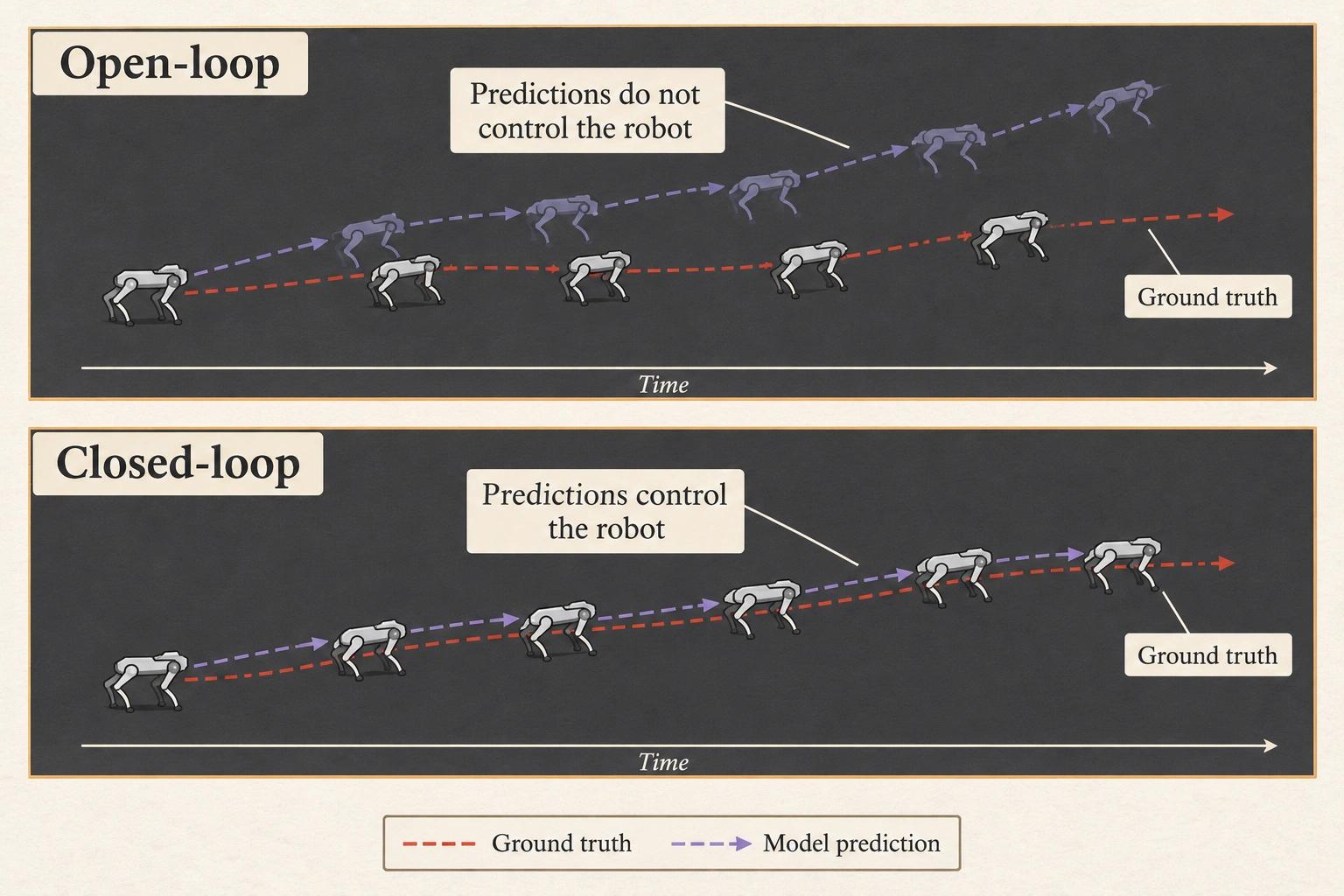
Open-loop: predictions are scored against a fixed ground truth but never control the robot — the feedback channel is missing, so errors go uncorrected and compound. Closed-loop: predictions actually control the robot, and every action shapes the next observation — the policy must live with the consequences of its own decisions.
The core principle is deceptively simple: generate additional relevant experience that results from iteratively executing the policy, ensure this experience is realistic enough to avoid sim-to-real failure modes, then update the policy with an objective aligned to desirable task performance. However, achieving this in practice requires navigating a complex design space with fundamental trade-offs.
How It Works in Practice
If open-loop BC is supervised learning on a fixed dataset, what does a closed-loop training iteration actually look like? Three steps, repeated:
- Roll out the current policy in simulation (rarely the real world): it acts, the environment responds, and it visits states of its own making — including its own mistakes. No reference is needed here; the environment simply produces the next observation.
- Score the rollout. This is where the reference enters, and it is exactly Design Axis 3: in closed-loop imitation, an expert — human, privileged simulator expert, or heuristic anchored to the recorded trajectory — labels the states the policy visited; in RL, a reward function evaluates each state-action instead, no expert required; hybrids learn the reward from demonstrations or preferences.
- Update and repeat: supervised loss on expert-labeled states (aggregated into the dataset, DAgger-style) or policy gradient on rewards. The next rollout uses the new policy, so the training distribution tracks the policy's own failure modes as it improves.
In short: the rollout generates the states; the objective — expert labels or reward — scores them.
The Three-Axis Design Space
Modern closed-loop training approaches can be understood through three interdependent design axes, each presenting distinct trade-offs that shape the entire training pipeline.
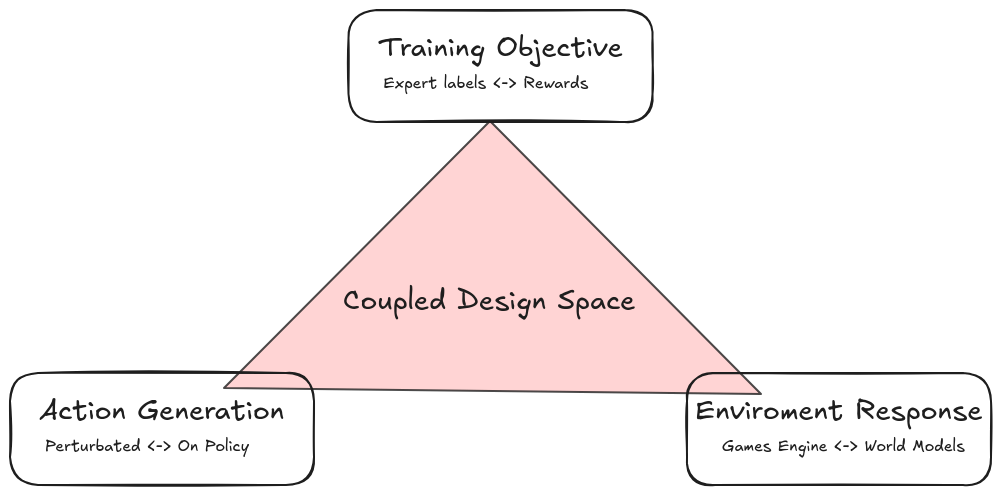
The three design axes of closed-loop training. Choices along one axis constrain the others — there is no universally optimal combination.
| Design axis | Question | Spectrum | Key trade-off |
|---|---|---|---|
| 1. Action generation | Who produces the actions during training? | Perturbed demonstrations ↔ guided/stale rollouts ↔ fully on-policy | On-policy data targets real failure modes but is expensive and drifts from expert data |
| 2. Environment response | Where do new observations come from? | Game engines ↔ neural reconstruction ↔ generative video ↔ latent world models | Fidelity and structure vs. flexibility and cost |
| 3. Training objective | What converts experience into a learning signal? | Closed-loop imitation ↔ RL ↔ hybrids | Expert labels break far from demos; rewards are hard to specify |
Part III: Design Axis 1 — Generating Actions
Passive Perturbation: Efficiency Without Specificity
At one extreme: modify expert demonstrations independently of the learned policy — add noise to recorded trajectories or intentionally deviate from optimal paths, forcing the system to practice recovery maneuvers.
Cheap and trivially parallelizable: perturb once, reuse across training runs. The limitation is specificity — the perturbations are generic and cannot target the actual mistakes the policy makes in deployment.
Active Rollouts: On-Policy Experience at Computational Cost
At the other extreme, the current policy itself controls the agent (typically in simulation) and experiences the consequences of its decisions firsthand. When it errs, it lands in exactly the states it will face in deployment — the most effective antidote to covariate shift.
The cost: data must be regenerated after every policy update, and poor early policies produce mostly low-quality experience.
The Middle Ground: Guided and Filtered Rollouts
Between the extremes lies a rich landscape of hybrids. Guided rollouts constrain the policy to remain near ground-truth trajectories, balancing exploration with valid supervision. A notable example is the Closest Among Top-K (CAT-K) strategy: sample multiple actions from the policy at each step, execute the one whose outcome lands closest to the expert trajectory.
Stale policy rollouts reuse data from previous iterations, trading on-policy coverage for compute efficiency — valuable early in training, when the policy changes fast. Tree search or post-hoc filtering can also remove undesirable behaviors from generated data, acting as a "policy improvement operator" before training.
Key takeaways — action generation
- Perturbed demonstrations are cheap and reusable, but they teach generic recovery — not the mistakes your policy actually makes.
- Fully on-policy rollouts target the policy's own failure modes; the price is regenerating data after every update.
- Practical sweet spot: guided rollouts like CAT-K keep expert supervision valid while sampling from the policy's own distribution.
Part IV: Design Axis 2 — Generating Environment Responses
The Core Challenge: High-Fidelity Sensor Simulation
End-to-end policies consume raw sensor input — camera images, LiDAR point clouds — so closed-loop training must synthesize new observations for hypothetical actions, faithfully enough to avoid sim-to-real gaps that would undermine the whole process. This is the hardest technical part of the pipeline.
Traditional Game Engine Simulation
Game engines like CARLA render 3D scenes from explicit geometry, offering perfect ground truth and controllable scenarios — the long-standing foundation of closed-loop research.
But the perceptual gap to real images remains large (lighting, materials, atmosphere), and hand-building detailed 3D assets for every new city, warehouse, or road type doesn't scale economically.
Neural Reconstruction: Photorealism Anchored to Reality
NeRF and 3D Gaussian Splatting take a data-driven route: learn a photorealistic scene from multi-view sensor footage, then render novel viewpoints. Systems like AlpaSim show this can reach remarkable fidelity while anchored to real logs — reflections, shadows, atmosphere included, without manual asset creation.
The catch is generalization: quality degrades quickly for states far from the recording — turn left where the log turned right and the rendering breaks down. Rollouts must stay within a "validity corridor", which is exactly what guided rollouts provide.
Generative Video Models: Flexibility at the Cost of Structure
The newest frontier: synthesize frames directly with diffusion or autoregressive architectures instead of rendering from 3D. Models like GAIA-2 and Cosmos-Drive generate diverse, long-tail scenarios on demand — potentially from language specifications — and TeraSim conditions on StreetView imagery and external traffic models for high-fidelity, safety-critical simulation.
The cost is structure. Without explicit 3D grounding, temporal consistency is hard (objects morph between frames) and reward computation suffers — how do you measure collision risk without object boundaries? Hybrid approaches that combine geometric grounding with generative refinement are the current direction.
Latent World Models: Abstraction for Efficiency
Latent world models skip sensor-space simulation entirely: learn forward dynamics over the policy's own feature representations, predicting future latents from past latents and actions. They model only what matters for decisions, not foliage or background clutter — dramatically cheaper.
The catch: tight coupling to the policy (retrain when it changes), quality bounded by the informativeness of the latent, and no reliable metrics for assessing latent prediction quality.
| Approach | Visual fidelity | Generalization beyond logs | Structure for rewards | Compute cost |
|---|---|---|---|---|
| Game engines (CARLA) | Low–medium | High (free movement) | High (explicit 3D) | Medium |
| Neural reconstruction (NeRF/3DGS) | Photorealistic near logs | Low (validity corridor) | Medium | Medium–high |
| Generative video / world models | High and diverse | Medium–high | Low | High |
| Latent world models | n/a (feature space) | Tied to policy | Low–medium | Low |
Interactive Agent Simulation: The Social Element
Visual rendering is only half of it — the other agents must behave realistically too. Overly conservative agents that always yield produce aggressive policies; non-reactive agents replaying logs ignore the ego agent entirely. Options span log-replay (perfect fidelity, zero reactivity), rule-based models like IDM (reactive but brittle in complex scenes), and learned interaction models (the most flexible). The critical requirement: the policy must not be able to exploit unrealistic behaviors — a policy trained where everyone always yields fails among real humans.
Key takeaways — environment response
- Explicit 3D simulators like CARLA give perfect labels and control, but asset creation doesn't scale; learned reconstruction (NeRF/3DGS) scales with data instead — which is why open stacks like AlpaSim are gaining traction.
- Generative world models (GAIA-2, Cosmos) win on diversity and long-tail generation, but their missing 3D structure makes rewards and evaluation hard.
- The metric that matters is not pixels but policy-oriented realism: does training in this sim change the policy the same way reality would?
Part V: Design Axis 3 — Defining Training Objectives
Closed-Loop Imitation Learning: The Expert Label Problem
Closed-loop imitation extends imitation to policy-induced states. The problem: demonstrations only define desirable behavior along recorded trajectories, but rollouts inevitably leave them. What is the correct action in a state the expert never visited?
On-Demand Expert Querying: The classical answer is DAgger: query an expert to label the states the policy visits, turning quadratic error growth into near-linear regret by making the expert "defined" wherever the policy goes. On-demand humans don't scale, so modern implementations query privileged simulator experts with access to ground-truth maps and object states — consistent supervision across the state space.
Closed-Loop Reweighting: A pragmatic middle ground between open-loop BC and full closed-loop training comes from CW-ERM. Train a standard BC policy, roll it out in a simulator, and upsample the training scenes where it fails closed-loop metrics (collisions, deviation from reference). The final policy is still trained open-loop — no simulator in the training loop — yet the authors report collision reductions of around 35% on some metrics. The idea connects to classic covariate-shift correction via density-ratio estimation: samples that matter for the test distribution get higher weight.
Recovery Heuristics and Guided Rollouts: When expert queries are impractical, recovery heuristics are the simpler option: geometric controllers steering back to a reference, PID controllers maintaining distances, trajectory optimization targeting expert states. Guided rollouts from Part III serve double duty here — by anchoring rollouts to expert trajectories (CAT-K), expert labels stay valid during on-policy exploration.
Latent Model-Based Imitation: A latent world model can also act as a differentiable simulator: backpropagate through time from a similarity loss between predicted and expert-derived latents. Richer signal than single-step imitation, at a fraction of the cost.
Reinforcement Learning: Learning from Consequences
RL replaces the expert with a reward function that can be evaluated anywhere. The policy learns from trial and error, handles closed-loop dynamics natively, and can in principle surpass human performance in specific scenarios.
The Reward Design Challenge: Encoding human-like behavior — safety, efficiency, smoothness, social convention — into a scalar reward is notoriously hard. Poor specifications invite reward hacking: policies that drive aggressively to maximize progress, slam on brakes to avoid collision penalties, or exploit simulator bugs. Even minor misspecifications in edge cases can be catastrophic.
Sample Efficiency and Computational Demands: RL is sample-hungry. Simplified settings already consume hundreds of millions of environment steps; with high-dimensional visual input, compute pushes current infrastructure. On-policy methods like PPO put simulation inside the training loop — every gradient step waits for fresh experience — so training in days rather than months requires simulation speeds of 10⁴ to 10⁵ steps per second.
Action Representation Challenges: Embodied policies often output multi-second trajectories, not instantaneous actions. Treating trajectories as actions inflates variance; tokenized actions complicate the mapping; diffusion policies don't expose the log-probabilities policy gradients need. Specialized RL algorithms for these architectures remain underexplored.
Hybrid Approaches: Combining the Best of Both Worlds
The most promising path combines both paradigms, trading some dependence on demonstrations for efficiency and robustness.
Imitation-Based Rewards: Ground RL objectives in demonstrations — penalize deviation from expert trajectories, learn rewards via inverse RL, or train a discriminator (adversarial imitation) to distinguish expert from policy behavior and use its output as reward. This ties RL to the only direct evidence of desirable behavior — human demos — while enabling reasoning about delayed consequences. The complexity shifts from learning a generalizable policy to learning a generalizable reward, which may be equally hard.
Sequential IL and RL: Pre-train with behavior cloning, fine-tune with RL — the same pre-train/align recipe that transformed large language models. Imitation provides a human-like baseline; RL improves robustness where demos are inconsistent or suboptimal. The fragile point is the handoff: critics trained on static data overfit to the behavior policy, then extrapolate badly on rollouts, biasing estimates and diverging the policy. Remedies include conservative critics, advantage filtering, critic-free methods, and preference-based alignment like Direct Preference Optimization.
Teacher-Student Schemes: Train a privileged teacher with RL on structured world states, then distill it into a sensor-based student via imitation. Perfect information makes the teacher efficient to train — and unlike human experts, it can be queried on any state, enabling DAgger-style closed-loop imitation without humans. Multi-agent self-play for training such teachers is a particularly promising direction.
Key takeaways — training objectives
- DAgger's core idea — label the states the learner visits — turns quadratic error into near-linear regret; privileged simulated experts make it practical at scale.
- Rewards buy evaluate-anywhere flexibility but invite hacking; imitation-derived rewards (GAIL) and preference methods (RLHF, DPO) ground objectives in human data without hand-crafting reward functions.
- IL pre-train → RL fine-tune mirrors the LLM recipe; the fragile part is the handoff — critics overfit to the behavior policy.
- Teacher–student distillation solves the "queryable expert" problem: train a privileged RL teacher, then imitate it with a sensor-based student.
- If full closed-loop training is too expensive, closed-loop reweighting (CW-ERM) captures much of the benefit: upsample the scenarios where the policy fails in simulation — ~35% collision reduction, no simulator in the training loop.
Part VI: The Coupling Problem
Why These Choices Are Interdependent
A critical insight: the three axes cannot be optimized independently — each choice constrains the others.
- Action generation ↔ environment fidelity: fully on-policy rollouts drift far from real logs, exactly where neural reconstruction loses fidelity — forcing guided rollouts or post-hoc filtering.
- Training objective ↔ action generation: expert labels stay valid only near demonstrations, which limits how on-policy closed-loop imitation can go — pushing the field toward off-policy variants or hybrids.
- Environment ↔ training objective: RL needs structured world states to compute rewards (collision boundaries, physical constraints); generative video excels at realism but lacks them — the objective constrains the viable simulators.
- Data requirements across all axes: RL wants high throughput and low latency, since simulation sits inside the training loop. Imitation is forgiving — data generation can be decoupled from updates and run slower, at higher fidelity.
There is no single "best" approach. The optimal design depends on available compute, deployment constraints, safety requirements, and the specific operational domain.
Part VII: Emerging Frontiers
Vision-Language-Action Models: Reasoning Before Acting
The year 2025 has witnessed a surge in Vision-Language-Action (VLA) models that depart from traditional end-to-end architectures: by integrating visual perception with the reasoning capabilities of large language models, they offer a path to the long tail through linguistic reasoning and spatial awareness — across robotics, not just in any single application.
Models like Alpamayo-R1 introduce explicit reasoning chains into action prediction, enabling the system to "think through" complex decisions before committing to a trajectory — verbalizing rules, hazards, and social norms instead of directly mapping observations to actions. SpaceDrive advances this by treating spatial information as explicit positional encodings rather than simple text tokens, allowing joint reasoning over semantic and spatial representations.
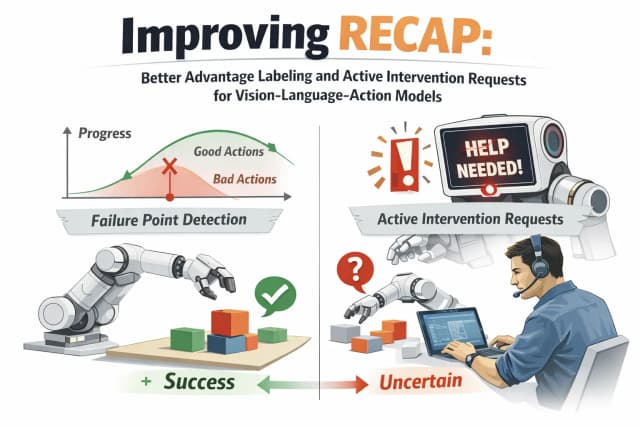
RL-based approaches inspired by DeepSeek-R1 let models develop Chain-of-Thought reasoning through trial and error in interactive environments. Early results suggest this intermediate reasoning step improves both performance and interpretability, though costs remain substantial. For a concrete example of how VLAs can improve through RL-style feedback on their own failures, see my earlier post on π*0.6 and RECAP.
Scaling Laws: Understanding the Data-Performance Relationship
Much like large language models, embodied AI is increasingly dominated by the study of scaling: do power laws — performance growing predictably with model size, dataset size, and compute — apply to embodied policies?
Evidence suggests they do emerge in world modeling and behavior cloning under generative pre-training, but their nature differs from language. In world modeling, the optimal model-vs-data trade-off is heavily influenced by the tokenizer's compression rate; in behavior cloning with tokenized observations, scaling laws are harder to observe under modest compute budgets.
Industry practice shows clear data scaling: experiments on driving datasets from 16 to 8,192 hours show log-linear performance gains, and a 5% improvement in motion prediction accuracy maps to a specific required increase in training data. Large-scale models like StateTransformer-2 generalize across billions of real-world scenarios through decoder-only architectures that scale steadily in both prediction and planning.
The takeaway: scaling remains a viable path, but architectural efficiency matters far more in embodied agents than in pure text models. "Bigger is better" needs careful qualification.
Key takeaways — emerging frontiers
- Reasoning helps exactly where imitation is weakest: Alpamayo-R1 reports +12% planning accuracy on long-tail cases, a 35% reduction in close-encounter rate, and +45% reasoning quality from RL post-training.
- DeepSeek-R1 showed RL alone can induce reasoning; transferring that to embodied agents is the active frontier — RECAP is an early instance.
- Scaling laws exist for embodied models but are tokenizer-bound; architectural efficiency beats raw size (StateTransformer-2).
Part VIII: The Path Forward
Critical Research Directions
| Direction | Why it matters |
|---|---|
| Training-oriented simulation | Fidelity that matters for policy learning rather than photorealism; throughput and latency for on-policy RL; principled metrics for policy-oriented realism |
| RL for modern architectures | Tokenized and diffusion-based actions, large VLAs, robust value estimation for high-dimensional input; stable IL→RL handoffs |
| Reward learning and alignment | Objectives grounded in demonstrations and preferences instead of hand-crafted rewards; affordable high-quality human feedback |
| Robust agent simulation | Simulated agents that are realistic and not exploitable; co-evolution of traffic models and ego policies via adversarial or curriculum learning |
| Curriculum and adversarial generation | Actively discover policy weaknesses and generate targeted, plausible challenges instead of passively collecting diverse data |
| Catastrophic forgetting | Improve on targeted scenarios in closed-loop fine-tuning without regressing on others |
Industry Implications
The shift beyond behavior cloning reshapes resource allocation: data collection versus simulation infrastructure, when to move from open-loop to closed-loop training, and how to co-design simulation, objectives, and action generation rather than optimizing them in isolation. Heavy compute requirements favor large organizations today — but data-efficient hybrid methods may let smaller players compete through algorithmic innovation rather than pure scale.
Conclusion: From Imitation to Understanding
The evolution beyond behavior cloning is a shift in what we ask of embodied AI: not systems that mimic demonstrations, but agents that understand the interactive, causal nature of the physical world — learning from their mistakes, adapting to novel situations, and in some domains surpassing human performance.
The necessary technologies — neural rendering, generative world models, scalable RL, and reasoning-capable VLAs — have largely matured in isolation, and recent progress shows they can now be unified. Just as pre-training and alignment transformed language models, the combination of open-loop pre-training with closed-loop fine-tuning is becoming the standard paradigm for embodied agents.
The road to robust autonomy remains long, but the path has never been clearer: train policies that experience the consequences of their actions, learn from both success and failure, and reason through complex scenarios. Systems that don't just act in the world — but understand how the world reacts.
References & Further Reading
Foundation
- Beyond Behavior Cloning in Autonomous Driving: a Survey of Closed-Loop Training Techniques — Karkus, Igl et al., NVIDIA, 2025. The taxonomy this article follows: three design axes, their trade-offs, and their couplings.
- DAgger: A Reduction of Imitation Learning and Structured Prediction to No-Regret Online Learning — Ross, Gordon, Bagnell, 2011. The original covariate-shift remedy: aggregate expert labels on the states the learner actually visits.
- CW-ERM: Improving Autonomous Driving Planning with Closed-loop Weighted ERM — Kumar et al., 2022. Debias a behavior-cloned policy toward closed-loop performance by upsampling scenes that fail in simulation rollouts — ~35% collision reduction with no simulator in the training loop. The project page has excellent open-loop vs closed-loop visualizations.
Simulation and world models
- CARLA: An Open Urban Driving Simulator — Dosovitskiy et al., 2017. Explicit 3D grounding, perfect labels, full control — the baseline for closed-loop research.
- NeRF: Representing Scenes as Neural Radiance Fields (2020) and 3D Gaussian Splatting for Real-Time Radiance Field Rendering (2023) — photorealistic reconstruction anchored to real sensor logs: fidelity without manual assets, generalization limited to a validity corridor.
- AlpaSim — NVIDIA, 2025. Open-source reconstruction-based closed-loop simulator; the practical starting point.
- GAIA-2: A Controllable Multi-View Generative World Model — Wayve, 2025. Controllable multi-view generative world model; long-tail scenarios on demand.
- Cosmos World Foundation Model Platform — NVIDIA, 2025. General-purpose world models for physical AI.
- TeraSim: Uncovering Unknown Unsafe Events through Generative Simulation — 2025. Generative traffic simulation aimed at safety-critical events.
Objectives: imitation, RL, and hybrids
- Proximal Policy Optimization — Schulman et al., 2017. The on-policy RL workhorse.
- GAIL: Generative Adversarial Imitation Learning — Ho & Ermon, 2016. RL with the reward learned from demonstrations.
- Deep RL from Human Preferences — Christiano et al., 2017. Reward learning from human feedback, the basis of modern alignment.
- Direct Preference Optimization — Rafailov et al., 2023. Preference alignment without an explicit RL loop.
- DeepSeek-R1: Incentivizing Reasoning Capability in LLMs via RL — 2025. Reasoning induced by RL; the template embodied reasoning is now following.
Embodied VLAs and scaling
- Alpamayo-R1: Bridging Reasoning and Action Prediction — NVIDIA, 2025. Chain-of-causation reasoning for long-tail planning; RL post-training lifts reasoning quality by 45%.
- SpaceDrive: Infusing Spatial Awareness into VLM-based Autonomous Driving — 2025. Spatial positional encodings for VLA driving.
- StateTransformer-2: Generalizing Motion Planners with Mixture of Experts — 2024. Decoder-only trajectory models that scale across prediction and planning.
- π*0.6 and RECAP — my earlier post on this blog: VLAs improving through advantage-labeled feedback on their own failures.